
DMe: The notification layer DeFi never built

The communication gap in DeFi
DeFi protocols today have a communication problem. Users interact with a frontend, close the tab, and never hear from the protocol again unless they come back to check. There is no push notification when a lending position approaches liquidation, no alert when LP fees pile up uncollected, no message when a governance vote needs attention. The entire relationship between protocol and user depends on the user remembering to show up.
Every other digital product solved this years ago. Banks send transaction alerts. E-commerce platforms notify you when an order ships. Streaming services remind you about new releases. DeFi, despite managing billions in user capital, still relies on Twitter threads, Discord channels, and the hope that users will check a dashboard at the right time.
What DMe is
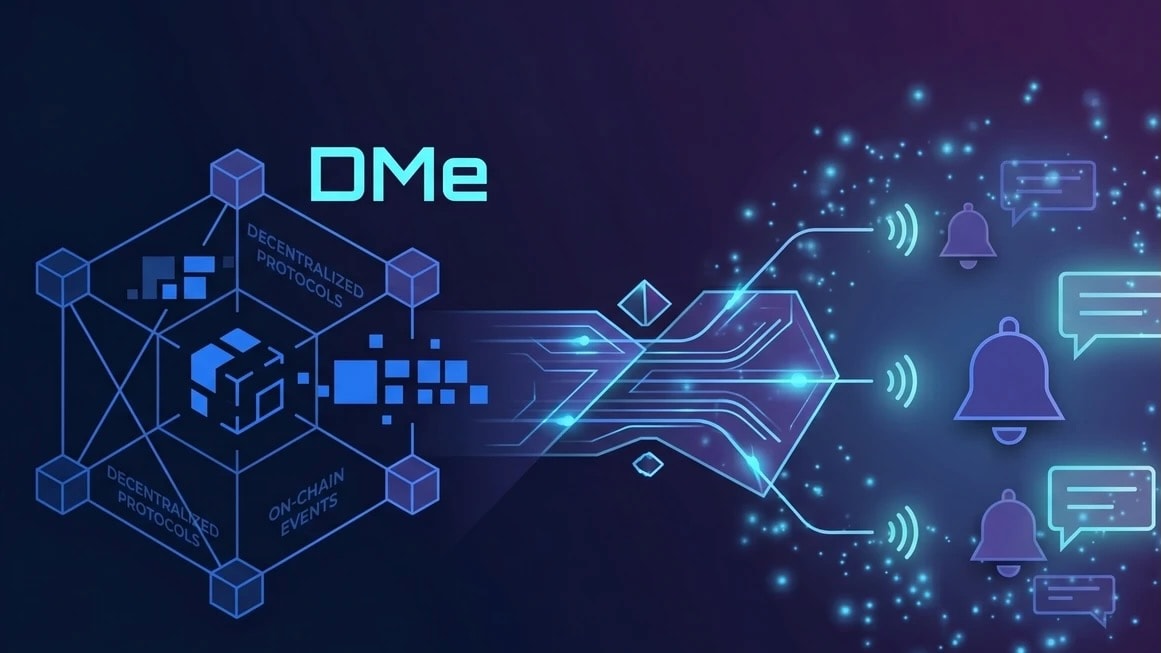
DMe is an open-source notification infrastructure layer built for DeFi protocols and DAOs. It connects wallet addresses to Telegram, enabling protocols to send personalized, wallet-aware messages to their users without requiring them to install anything, sign transactions, or connect a wallet upfront.
The core idea is simple: if a protocol knows what is happening on-chain with a user's position, it should be able to tell them about it in real time.
DMe handles the full stack: wallet-to-Telegram linking, message delivery, user preferences, and analytics. Protocols define their own signals (the on-chain events that matter), templates (how the message looks), and flows (when and to whom it gets sent). Everything else is infrastructure that DMe provides out of the box.
What protocols and DAOs can do with it
The use cases are as varied as DeFi itself. A DEX can alert liquidity providers when a position drifts out of range or when uncollected fees cross a threshold worth claiming. A stable pool like the StableSwap hook we built for Revert Finance could warn LPs when its amplification coefficient starts to ramp. A lending protocol can warn borrowers when their health factor drops near liquidation, or notify suppliers when deposit rates shift significantly.
DAOs can reach voters before a proposal deadline, notify delegates about new submissions, or send treasury updates to stakeholders. Yield aggregators can surface new opportunities the moment they go live. Bridges can confirm cross-chain transfers. Campaign platforms can remind operators when an incentive period is about to expire.
Protocols like Uniswap, Aave, Balancer, Pendle, Merkl, and MakerDAO all have events their users care about. Position summaries, rate changes, reward distributions, governance proposals. Today, most of those events go unnoticed until someone happens to open the right page at the right time.
How it works
DMe runs as a self-hosted, single-node service. A protocol deploys its own instance, keeping full control over user data and messaging logic.
Users onboard through a lightweight flow (a link or QR code powered by a React component) that connects their wallet address to Telegram. No wallet signature is required for the initial setup, which removes a major friction point for less technical users. It follows the same idea as our experiments with Porto: keep wallet steps out of the user's way.
Once linked, the protocol's DMe instance watches for configured signals (on-chain events, threshold breaches, scheduled checks) and delivers templated messages through Telegram. Each message can include context, actionable deep links back to the protocol's frontend, and relevant position data so users can act immediately.
An attribution dashboard tracks delivery rates and interaction metrics, giving protocol teams visibility into what notifications actually drive engagement.
Who this is for
DMe is designed for two audiences.
Protocol teams and DAOs that want to engage users proactively without building notification infrastructure from the ground up. If your protocol has on-chain events that affect user positions, capital, or governance participation, DMe gives you a direct and private channel to communicate that.
Users who are tired of checking dashboards, scanning block explorers, or relying on social media to find out when something important happens with their money. With DMe, the protocol comes to you with the right information at the right time.
Get involved
DMe is open source and ready for teams that want to close the communication gap with their users. Whether you are a protocol looking to reduce churn, a DAO trying to increase governance participation, or a developer who wants to extend the notification layer for DeFi, the repo is the best place to start.
Explore the code, read the DMe overview, open an issue, or reach out directly.
GitHub: BootNodeDev/dme-monorepo
If you want to discuss how DMe fits your protocol's stack, let's talk.